When planning financial transactions, business operations, or travel in the United States, understanding the difference between a bank holiday vs federal holiday is essential. Many people assume these terms mean exactly the same thing because banks and government offices often close on the same days. However, there are important legal and practical differences that affect businesses, employees, and consumers.
Whether you’re depositing a check, mailing important documents, scheduling payroll, or simply planning a day off, knowing how bank holidays and federal holidays work can help you avoid unnecessary delays. This guide explains everything you need to know in simple language, including definitions, comparisons, benefits, limitations, practical examples, and expert tips.
What Does Bank Holiday vs Federal Holiday Mean?
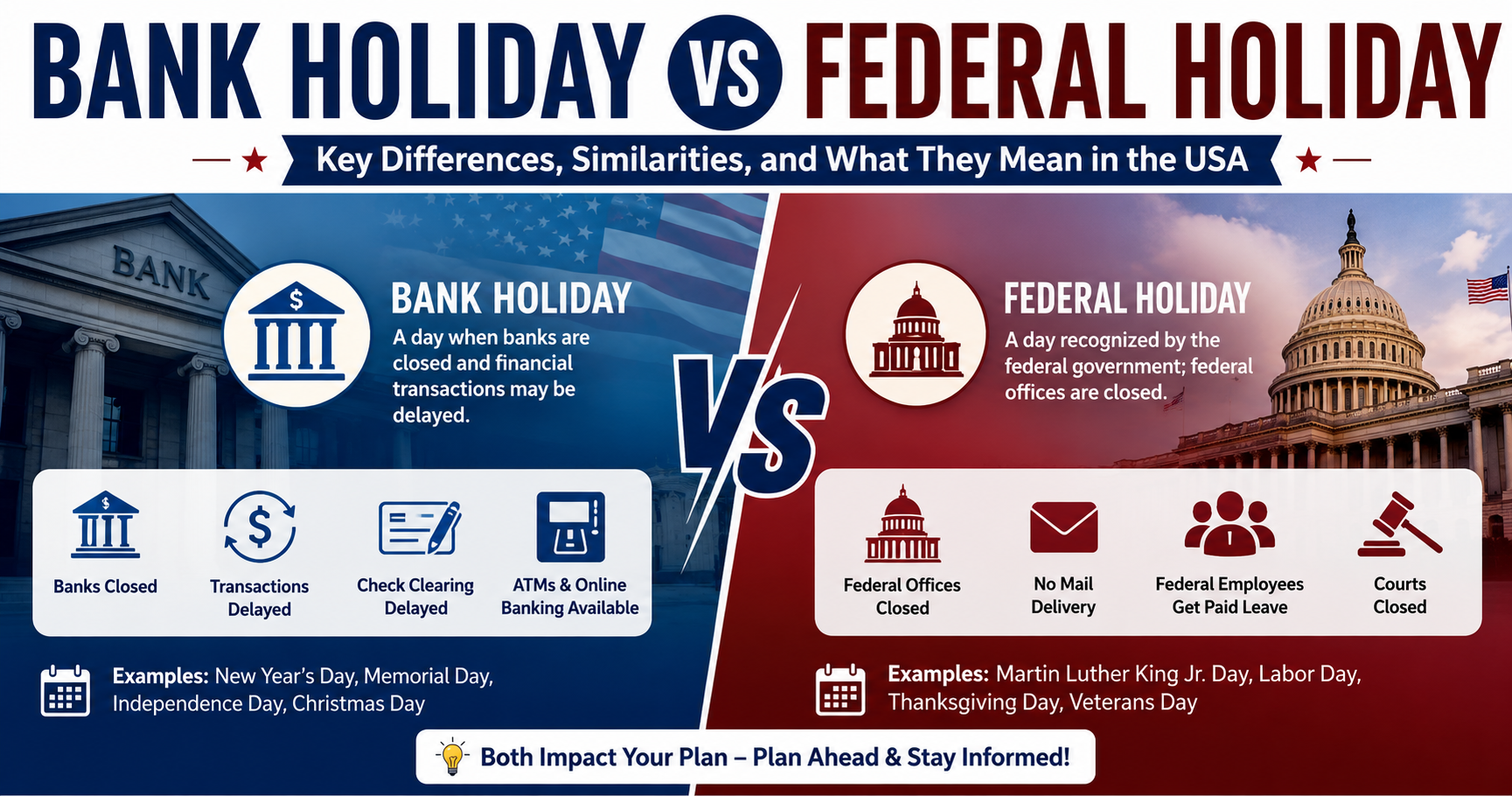
A bank holiday is a day when financial institutions such as banks are officially closed or provide limited services. During these holidays, many banking activities—including wire transfers, check processing, and in-person services—may be delayed until the next business day.
A federal holiday, on the other hand, is an official public holiday recognized by the United States federal government. Federal government offices close, and most federal employees receive paid leave. These holidays are established by federal law.
Although banks usually observe federal holidays, the two terms are not interchangeable.
Why the Difference Matters
Understanding the distinction helps you:
- Plan financial transactions.
- Schedule payroll processing.
- Avoid delayed payments.
- Know when government offices are closed.
- Manage business operations effectively.
How It Works
How Bank Holidays Work
Banks follow holiday schedules established by the Federal Reserve and banking regulations. On these days:
- Most bank branches are closed.
- ACH transfers may be delayed.
- Wire transfers usually stop processing.
- Check clearing may take longer.
- ATMs and online banking generally remain available.
How Federal Holidays Work
Federal holidays apply primarily to:
- Federal government agencies
- Federal courts
- Post offices
- National parks (some services)
- Federal employees
Private businesses decide independently whether to close.
Types or Categories
Bank Holidays
Common U.S. bank holidays include:
- New Year’s Day
- Martin Luther King Jr. Day
- Presidents’ Day
- Memorial Day
- Juneteenth
- Independence Day
- Labor Day
- Columbus Day
- Veterans Day
- Thanksgiving Day
- Christmas Day
Federal Holidays
The United States currently recognizes 11 federal holidays, all established by Congress.
Some states also observe additional state holidays that are not federal holidays.
Common Uses
People encounter bank holidays and federal holidays in many situations.
Banking
- Depositing checks
- Loan payments
- Mortgage processing
- Credit card payments
- Wire transfers
Government Services
- Passport applications
- Social Security offices
- IRS services
- Federal courts
- USPS operations
Business
- Payroll
- Accounting
- Shipping schedules
- Employee leave planning
Benefits
Benefits of Bank Holidays
- Allows banks to update systems.
- Gives banking staff scheduled time off.
- Improves operational efficiency.
- Helps maintain secure financial processing.
- Supports consistent nationwide banking schedules.
Benefits of Federal Holidays
- Provides paid leave for federal employees.
- Honors important historical events.
- Encourages family gatherings.
- Supports tourism and retail spending.
- Promotes national unity.
Limitations
Bank Holiday Limitations
- Delayed payments
- Slower check clearing
- Postponed wire transfers
- Limited customer support
Federal Holiday Limitations
- Government offices close.
- Passport services pause.
- Mail delivery may stop.
- Some public services become unavailable.
| Feature | Bank Holiday | Federal Holiday |
| Applies To | Banks | Federal Government |
| Established By | Banking regulations | Federal law |
| Banks Closed | Yes | Usually |
| Federal Offices Closed | Not always | Yes |
| Private Businesses Closed | Optional | Optional |
| Mail Delivery | Sometimes affected | Usually suspended |
| Online Banking | Available | Available |
| ATM Access | Available | Available |
Real-World Examples
Example 1: Paying a Mortgage
Sarah schedules a mortgage payment on Labor Day. Since it is both a bank holiday and a federal holiday, the payment is processed on the next business day.
Example 2: Receiving a Tax Refund
A taxpayer expects a refund deposit on Memorial Day. Because banks are closed, the deposit arrives the following business day.
Example 3: Mailing Important Documents
John visits the post office on Thanksgiving. Since it is a federal holiday, USPS retail locations are closed.
Practical Applications
Businesses rely on holiday calendars to:
- Process payroll
- Schedule direct deposits
- Manage invoices
- Coordinate supply chains
- Plan employee vacations
Consumers use these calendars to:
- Avoid banking delays
- Plan travel
- Schedule appointments
- Pay bills on time
Other Meanings of Bank Holiday
Outside the United States, the term bank holiday may simply mean a public holiday.
For example:
- In the United Kingdom, a bank holiday often refers to a nationwide public holiday.
- In Ireland, the term has a similar meaning.
- Some Commonwealth countries also use “bank holiday” to describe official public holidays.
Expert Tips
- Always check the annual Federal Reserve holiday calendar.
- Schedule important transfers one business day early.
- Use online banking for routine transactions.
- Avoid mailing urgent documents on federal holidays.
- Confirm whether your employer observes federal holidays.
- Businesses should update payroll calendars annually.
- Remember that weekends can extend holiday processing times.
- Plan international payments well in advance.
FAQs
Are bank holidays and federal holidays the same?
No. They often occur on the same dates but serve different purposes.
Do banks close on every federal holiday?
Most banks do, but policies may vary slightly by institution.
Can I use an ATM during a bank holiday?
Yes. ATMs generally remain operational.
Does online banking work on bank holidays?
Yes. However, transaction processing may be delayed.
Are private businesses required to close on federal holidays?
No. Most private employers decide independently.
Is Juneteenth a federal holiday?
Yes. Juneteenth became a federal holiday in 2021.
Will direct deposits arrive on a bank holiday?
Usually not. They are typically processed on the next business day.
Why are federal holidays important?
They recognize significant national events and provide paid leave for many federal employees.
Conclusion
Understanding the difference between a bank holiday vs federal holiday helps individuals and businesses plan more effectively. While both types of holidays often occur on the same dates, they serve different purposes. Bank holidays primarily affect financial institutions and transaction processing, whereas federal holidays govern the operations of the U.S. federal government.
Whether you are paying bills, managing payroll, scheduling travel, or visiting a government office, knowing which holidays affect which services can save time and prevent unnecessary delays. By planning ahead and checking official holiday schedules, you can ensure your financial and personal activities continue smoothly throughout the year.
Read More: Dream Meaning of Snakes: Complete Guide to Snake Dreams and Their Symbolism