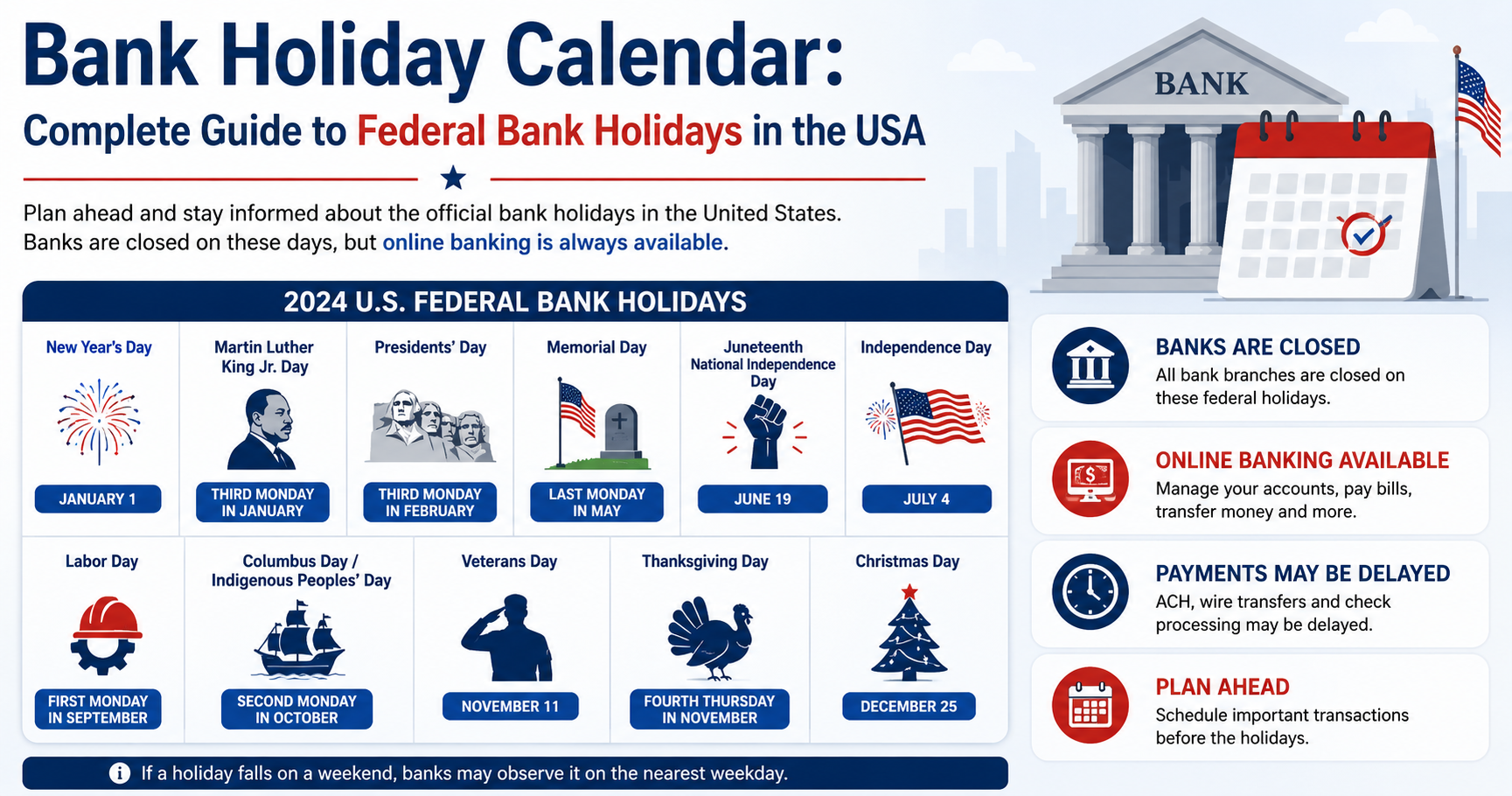
Whether you’re paying bills, depositing checks, sending wire transfers, or planning business payments, knowing the Bank Holiday Calendar is essential. Bank holidays can affect financial transactions, customer service, and payment processing, making it important to stay informed throughout the year.
Many people assume online banking means banks never close, but that’s not entirely true. While digital banking remains available on most holidays, certain services—including ACH transfers, wire transfers, and check clearing—may be delayed until the next business day. Understanding the bank holiday schedule helps you avoid unnecessary inconvenience.
What Is a Bank Holiday Calendar?
A Bank Holiday Calendar is an annual list of official holidays on which banks are generally closed for regular business. In the United States, these dates mostly align with federal holidays recognized by the government.
The calendar helps:
- Consumers plan banking activities
- Businesses schedule payroll and vendor payments
- Financial institutions organize operations
- Government agencies coordinate payment processing
Although many online services remain available, transactions requiring bank processing usually wait until the next business day.
Why Is a Bank Holiday Calendar Important?
A bank holiday calendar helps people avoid financial disruptions by showing exactly when banks will be closed.
It is useful because it:
- Prevents missed payment deadlines
- Helps schedule payroll
- Reduces transaction delays
- Improves financial planning
- Keeps businesses running smoothly
- Helps travelers prepare for banking needs
How Does a Bank Holiday Calendar Work?
The calendar follows official federal holidays observed throughout the United States.
Here’s how it works:
1. Banks Close on Scheduled Holidays
Most bank branches do not open on designated holidays.
2. Electronic Banking Continues
Customers can still use:
- Mobile banking
- Online banking
- ATMs
- Debit cards
- Credit cards
3. Payment Processing Pauses
Some banking functions wait until the next business day, including:
- ACH payments
- Wire transfers
- Check clearing
- Direct deposit processing
4. Business Resumes Normally
Banks reopen on the following business day unless another holiday or weekend follows.
Read More: Chinese Gender Predictor Chart: Meaning, Accuracy, and How It Works
Standard U.S. Bank Holiday Calendar
Below is the typical annual bank holiday schedule observed in the United States.
| Holiday | Typical Date |
| New Year’s Day | January 1 |
| Martin Luther King Jr. Day | Third Monday in January |
| Presidents’ Day | Third Monday in February |
| Memorial Day | Last Monday in May |
| Juneteenth National Independence Day | June 19 |
| Independence Day | July 4 |
| Labor Day | First Monday in September |
| Columbus Day / Indigenous Peoples’ Day | Second Monday in October |
| Veterans Day | November 11 |
| Thanksgiving Day | Fourth Thursday in November |
| Christmas Day | December 25 |
If a holiday falls on a weekend, banks may observe it on the nearest weekday.
Types of Bank Holidays
Federal Bank Holidays
These are holidays recognized nationwide and observed by most financial institutions.
State Holidays
Some states observe additional holidays that may affect local bank branches.
Institution-Specific Closures
Certain banks may close for maintenance, emergencies, or local events beyond the federal calendar.
Common Uses of a Bank Holiday Calendar
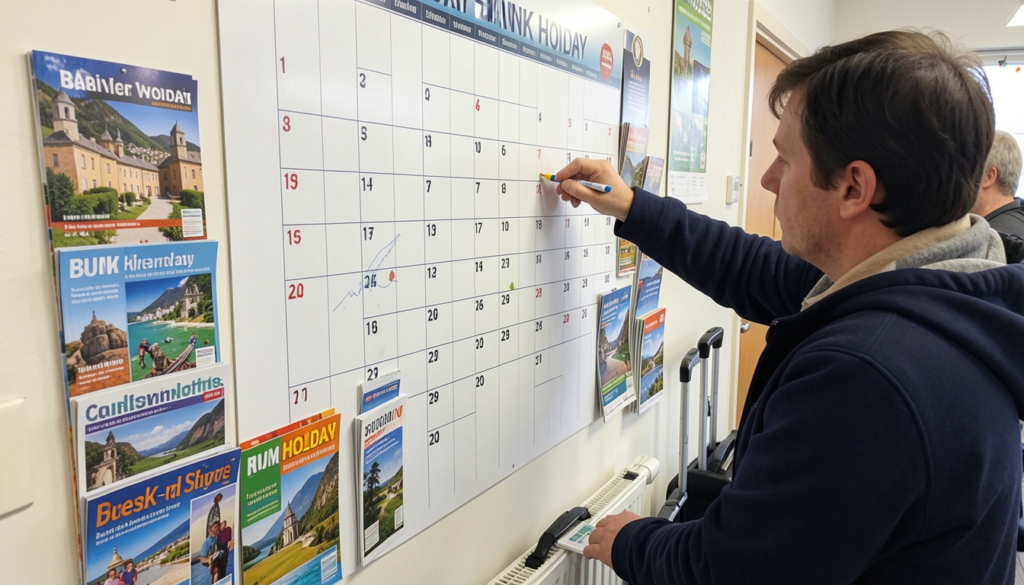
A bank holiday calendar is useful for many everyday financial activities.
People commonly use it to:
- Schedule direct deposits
- Plan mortgage payments
- Pay credit card bills
- Process payroll
- Send wire transfers
- Deposit large checks
- Manage tax payments
- Plan business cash flow
Benefits of Using a Bank Holiday Calendar
Knowing the holiday schedule offers several advantages.
Better Financial Planning
You can arrange payments before banks close.
Fewer Transaction Delays
Understanding processing times helps avoid surprises.
Improved Business Operations
Companies can prepare payroll and vendor payments in advance.
Better Customer Experience
Consumers avoid unnecessary trips to closed branches.
Easier Travel Planning
Travelers know when branch services may not be available.
Limitations of a Bank Holiday Calendar
While helpful, the calendar has some limitations.
- Online banking availability varies by service.
- Some banks maintain limited holiday support.
- International banking follows different holiday schedules.
- State-specific holidays may differ.
- Emergency closures cannot always be predicted.
Bank Holiday Calendar vs Regular Business Days
| Feature | Bank Holiday | Regular Business Day |
| Branch Open | No | Yes |
| ATM Access | Yes | Yes |
| Online Banking | Yes | Yes |
| Mobile Banking | Yes | Yes |
| ACH Processing | Usually Delayed | Normal |
| Wire Transfers | Usually Delayed | Normal |
| Check Clearing | Usually Delayed | Normal |
| Customer Service | Limited | Full Service |
Real-World Examples
Example 1
A business schedules employee payroll one day before Labor Day to ensure workers receive their salaries on time.
Example 2
A homeowner pays a mortgage several days before Thanksgiving to avoid processing delays.
Example 3
A traveler withdraws cash before Christmas because local branches will be closed.
Example 4
An online retailer schedules vendor payments before Memorial Day to maintain inventory deliveries.
Practical Applications
The bank holiday calendar is widely used across many industries.
Examples include:
- Personal banking
- Small businesses
- Government agencies
- Payroll departments
- Accounting firms
- Financial planners
- Retail companies
- E-commerce businesses
- Educational institutions
Other Meanings of “Bank Holiday”

Although commonly associated with banks, the term “bank holiday” may also refer to:
- National public holidays
- Government office closures
- Financial market holidays
- Regional public holidays in other countries
The exact meaning depends on the country and local regulations.
Expert Tips for Using a Bank Holiday Calendar
- Review the yearly holiday schedule in advance.
- Complete urgent transfers before holidays.
- Set automatic bill payments early.
- Keep emergency cash available.
- Use online banking for basic transactions.
- Monitor payment deadlines carefully.
- Businesses should plan payroll several days ahead.
- Check with your bank for holiday operating hours.
FAQs
What is a Bank Holiday Calendar?
A Bank Holiday Calendar is a yearly schedule showing the dates when banks are officially closed for business.
Are online banking services available during bank holidays?
Yes. Most online banking, mobile banking, ATMs, and card payments continue to work, although some transactions may be delayed.
Do direct deposits get delayed on bank holidays?
They can. If a scheduled deposit falls on a bank holiday, it is often processed on the next business day.
Are all banks closed on federal holidays?
Most banks close on federal holidays, but some branches may operate with limited hours depending on the institution.
Why should businesses follow the Bank Holiday Calendar?
Businesses use the calendar to schedule payroll, vendor payments, invoices, and financial transactions without unexpected delays.
Conclusion
A Bank Holiday Calendar is an essential planning tool for individuals, businesses, and organizations across the United States. By knowing when banks are closed, you can avoid payment delays, prepare payroll, schedule important transactions, and manage your finances more efficiently. Even though online banking offers round-the-clock access to many services, understanding the annual bank holiday schedule ensures smoother financial planning and fewer surprises throughout the year.